
Implementation
Join iLEAP’s Real World Testing
iLEAP is in its Real World Testing phase now, we are calling for industrial actors to pilot the iLEAP protocol and help validate its adequacy to the users needs.
The Real World Testing refers to the execution of tests using “real world” data. It requires communication between 2+ business partners running independent iLEAP-conforming software to exchange data. We strive to cover real-life end-to-end shipment cases.


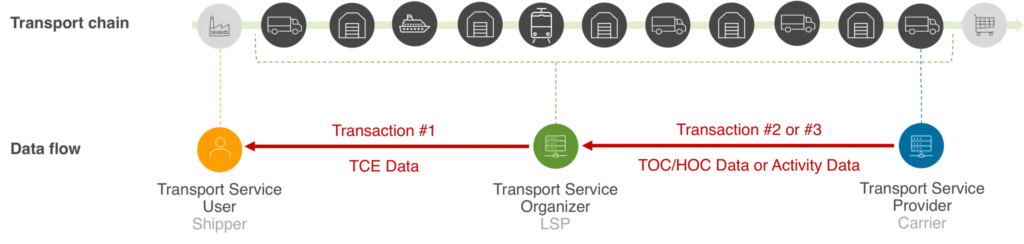
Schematic representation of the transactions (Chapter 4 of the Tech Specs).
The red arrows represent the most common use case.
However, under the right governance, Transactions 2 and 3 might also occur between a Transport Service Provider and a Transport Service User.
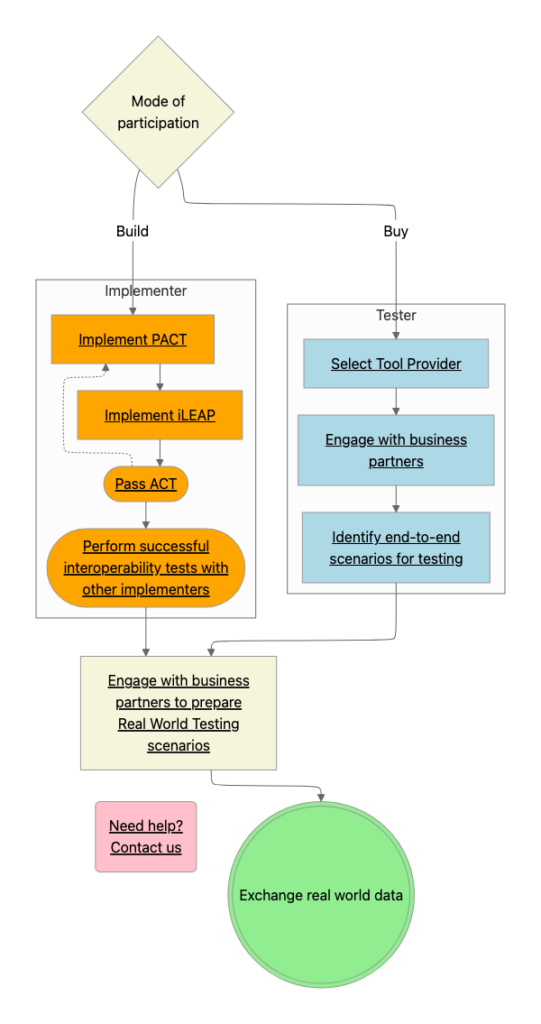
How to participate in the iLEAP Real World Testing?
Buying (user) mode
Buying means that you’re not implementing the iLEAP Technical Specifications, but rather using an existing software (from a tool provider).
— In this case, you are engaging as a user.
Building (implementer) mode
Building means that you are implementing the iLEAP Technical Specifications in your software, either for internal use or for offering services to others (i.e., buyers) as a tool provider.
— In this case, you are engaging as an implementer.
The diagram on the left helps you navigate the rest of the steps in the iLEAP Real World Testing, based on your participation mode.
What to do as a User (Buy)?
When engaging as a User, follow these steps to conduct iLEAP Real World Testing
01
Tool / Software Selection
-
Select a Tool / Software Solution that implements iLEAP. Check out this spreadsheet for overview of which tool have implemented iLEAP.
02
Your Business Partner
-
Check if your business partners are already part of iLEAP Real World Testing.
-
If not, bring additional business partners to pilot with you.
-
The project team can help to check if your business partners is already joining iLEAP or onboard your designated partner to the project ! Among other things, we can also help draft a multi-party NDA if needed.
03
Scope the Data Exchange
-
Identify the relevant logistics activities for data exchange. For example, movements between port pairs over a period of time, or a chosen road transport lane.
-
Select non-business-sensitive demo data
-
Engage with the selected tool to provide you the necessary data.
04
Commitments & Resources
As a user, here is the estimate commitment and resources needed to complete your iLEAP Real World testing
Persons and Background
- GLEC Framework Expert(s): 1+ persons with good understanding of the GLEC Framework/ ISO14083 standard.
- IT and Integration Specialists: 1+ persons with IT background, in case the iLEAP tool needs to be be integrated into your existing IT systems or to make data available to the GLEC Framework Expert(s).
Time Commitment
- Step 1 and 2 can take less than a week or more, depending on the use of an iLEAP implementing tool, and your engagement with business partners, etc.
- Phase 3 takes 1.5 hour per week commitment over approximately three months
What to do as an Implementer (Build)?
When engaging as a Implementor, follow these steps to conduct iLEAP Real World Testing
01
Implement & Test
-
-
Test your implementation with our free conformance tool ACT
-
Perform interoperability tests with other implementers (using mock data). We recommend engaging with at least two other implementers (See here for overview). Check out the guidance and test cases here.
-
Reach out to the iLEAP project team to support you with ACT and with bi-lateral interoperability tests
02
Testing with your Clients
-
Find customers willing to participate in Real World Testing. Check out this spreadsheet for interested companies.
03
Scope the Data Exchange
-
Identify the relevant logistics activities for data exchange. For example, movements between port pairs over a period of time, or a chosen road transport lane.
-
Select non-business-sensitive demo data to be exchanged.
04
Commitment & Resources
As a implementor, here is the estimate commitment and resources needed to complete your iLEAP Real World testing.
Persons and Backgrounds
-
- GLEC Framework Expert(s): 1+ persons with good understanding of GLEC Framework/ ISO14083 standard.
- Product Manager: 1 product (project) manager to oversee the iLEAP implementation.
- Developer(s): 1+ developers implementing iLEAP Technical Specifications. At best, with GLEC Framework knowledge.
Time Commitments
- Step 1 takes less than a week or more, depending on product and implementation strategy.
- Step 2 takes less than a week or more, depending on exisiting relationships and partners’ commitment.
- Step 3 takes 2-3 days a month for tri-weekly calls plus partner’s coordination.
03